

What a low hit rate world demands of portfolio managers – and of the people who hire them.
By Clare Flynn Levy

Clare Flynn Levy is CEO & Founder of Essentia Analytics. Prior to setting up Essentia, she spent ten years as a fund manager, in both active equity (running over $1B of pension funds for Deutsche Asset Management), and hedge (as founder and CIO of Avocet Capital Management, a specialist tech fund manager).
One of the most uncomfortable days of my career as a fund manager came when an investor in my hedge fund – a technologist, not a finance person – showed me a chart of my own decisions.
In three years, 47.4% of my ideas had produced positive excess returns. My hit rate, in other words, was sub-50%.
I remember feeling embarrassed. I had been marketing myself as an exceptional stock picker, and here was the evidence that I got it wrong more often than I got it right.
But that was not the point, my investor said. What I needed to understand was the other side of the equation: my average winner was generating 134bps of excess return at the portfolio level. My average loser was destroying 120bps. My payoff ratio, in other words, was 111%. Not bad, in and of itself, but with a 47% hit rate, a 111% payoff ratio was just breaking even.
I had been running very hard to stay in exactly the same place.
The probability of being wrong has gone up. So has the cost.
That was my problem two decades ago. Today it is everyone’s problem – and it is worse than ever.
Markets have been extraordinarily narrow. Over the three years to 30 June 2026, only around 40% of MSCI Europe constituents outperformed their own index – and that was the high end of all the indexes we looked at. At the low end, roughly one in five constituents of the MSCI EM ex China did. Over the same period, the median active equity manager in the Behavioral Alpha Benchmark had a hit rate of 36%. Better than the benchmark itself, in most cases, but cold comfort.
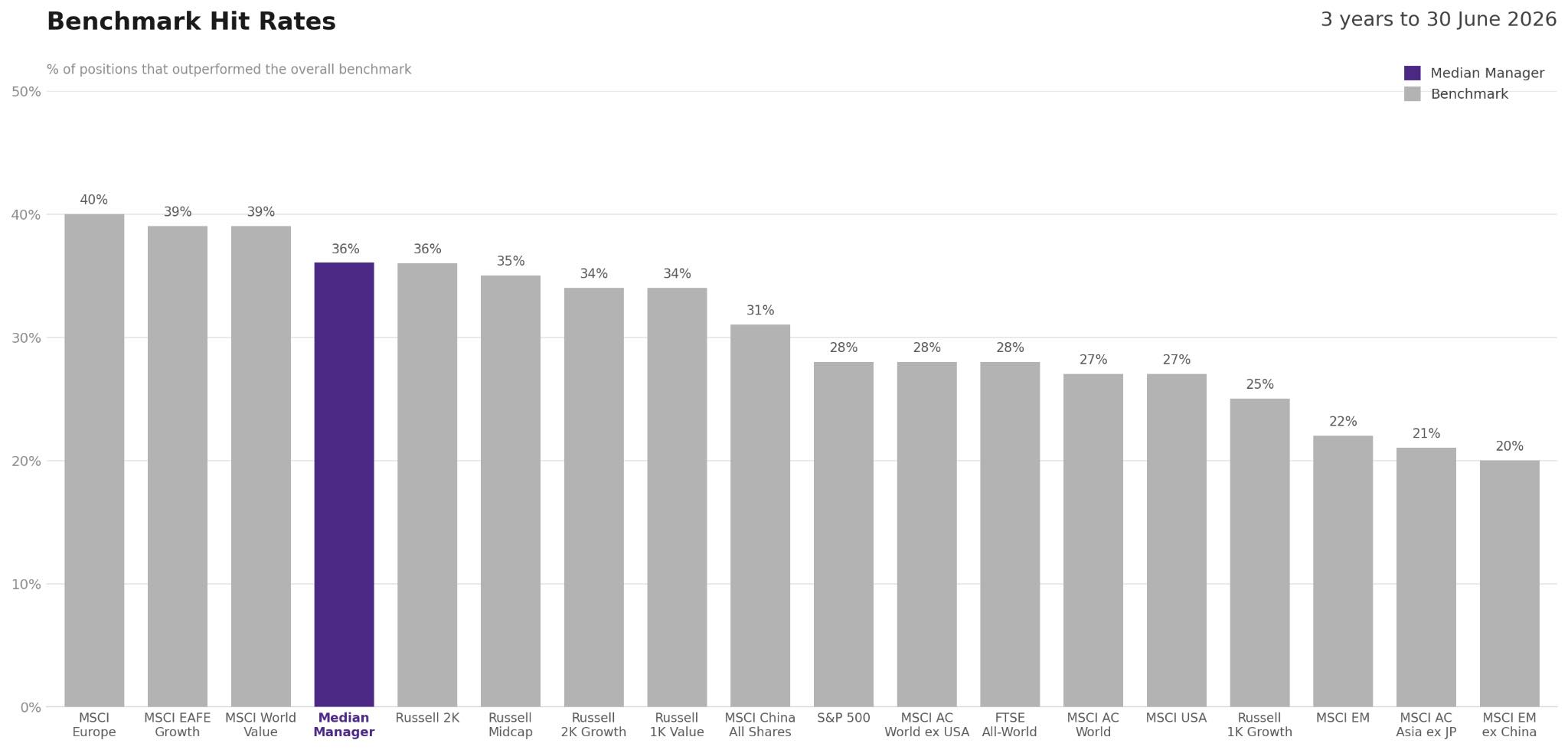
Our analysis of stock-picking hit rates shows that most positions in an index underperform the overall benchmark.
And it is not only that being wrong has become more likely. It has become more expensive. A small handful of stocks have always driven a disproportionate share of returns in any given year. What is different now is that those stocks also carry the largest market caps. Being underweight any one of them has an outsized effect on relative performance.
This is structural, not cyclical
It would be comfortable to treat this as a phase to be waited out. The evidence says otherwise. More and more of the decisions being made in the market have nothing to do with fundamentals. A few examples:
- Passive vehicles. Record flows into index funds compound the concentration problem rather than correct it.
- Factor-driven allocation. Capital is increasingly allocated on risk characteristics rather than on company fundamentals.
- Basket swaps. Exposure to themes is increasingly being taken wholesale, rather than name by name.
- Algorithmic trend-following. A large share of today’s market participants are, in effect, momentum investors – by construction, they are trading on what prices have already done.
Robert Hagstrom describes fundamental investing as a cathedral, a place of deep intellectual practice, with a casino attached. Today, the casino has quietly subsumed the cathedral. Active management cannot wait this out.
The math is unforgiving
The relationship between hit rate and payoff ratio is simple:
breakeven payoff ratio = (1 – hit rate) / hit rate
The lower your hit rate, the higher the payoff ratio you need just to keep up. That median manager on a 36% hit rate needs a payoff ratio above 170% simply to break even against the benchmark. Their average winner has to generate more than 1.7 times the alpha their average loser destroys.
The lower your hit rate, the higher the payoff ratio you need just to keep up.
Being wrong most of the time is no longer a failure of skill; it’s just the reality of being an active manager. The question is what you do about it.
Where the game is won
Here’s how you should think about your own process, or, if you’re an allocator, about the managers you hire.
Hit rate rests on one decision type: stock picking. In this market, it is also the decision you have the least control over.
Payoff ratio rests on six: position sizing, entry timing, scaling in, size adjusting, scaling out and exit timing. Every one of them is a sizing or timing decision – and every one of them is both measurable and improvable.
Essentia measures all seven separately, for every manager. And we do it because six of the seven are where the remaining edge – the Behavioral AlphaⓇ – lives.
What the best managers do differently
In March I published my first book, Stock Market Maestros, co-authored with Lee Freeman-Shor. We took a shortlist of 73 active equity managers, all of them recent award winners from Morningstar, Lipper, Investment Week and others, and analyzed their actual trading histories.
Behavioral biases are visible in daily holdings data, and where they are, there’s alpha to be gained.
Across that shortlist, the average hit rate was 45% and the average payoff ratio was 137%. Among the twelve managers who made the final cut – the Maestros – the hit rate was 49% and the payoff ratio was 182%.
Note what did not separate them. The Maestros are not distinguished by better ideas. Their hit rates are good, but not particularly exceptional. Three things showed up again and again:
- They are continuous improvers. Their process is constantly adapting. They take the time to learn from mistakes and build systematic ways to avoid repeating them.
- They have sizing rules. Not one of them sizes a position on conviction alone. A position has pre-set hoops to jump through before it deserves more capital.
- They have a process for knowing when they are wrong – and acting on it. They decide, before they get in, how they will know if they are wrong. Then they set alarms that force them to revisit the position as objectively as possible.
Be cognizant of expensive behaviors
Behavioral biases like loss aversion, the disposition effect, the endowment effect, and repurchase bias are all visible in daily holdings data, and where they are, there’s alpha to be gained.
Essentia’s Alpha Lifecycle research, covering 43 portfolios over 14 years, found roughly 120bps a year of alpha opportunity sitting inside a single behavior: holding positions past the point at which they are adding value.

Four questions to ask
If you allocate to active managers, ask these four questions in your next manager meeting. If you run money, ask them of yourself first – before someone else does.
- What is your hit rate, and what is your payoff ratio?
- Show me a position you got wrong. Not a small loss – one that hurt. What made you realize you were wrong, and how long did it take you to act?
- What is your ongoing process for recognizing when you are wrong and doing something about it? Do you have systematic rules?
- What have you changed about your process in the last three years, and on what basis did you change it?
These questions are not about testing intelligence. They’re about testing whether a manager has what it takes to generate a high payoff ratio in a low hit rate world.
Allocators: now turn the questions on yourselves
It would be easy to read all of the above as a problem that is unique to your underlying managers. It is not.
Manager selection is stock picking by another name. You form a thesis. You size a position. You add, you trim, and eventually you exit. The same seven decision types. The same biases. A slower feedback loop, which makes the biases harder to see, but not weaker.
So: are you, as a selector of managers, a continuous improver? What have you changed about how you select and review managers in the last three years, and what evidence made you change it? Do you size a manager on conviction alone, or does a manager have hoops to jump through before they are given more of your capital? And how will you know you are wrong about this manager – decided before you hire them, not after?
There is both art and science to being good at being wrong. The art is in knowing which questions to ask. The science is in knowing when to ask them.
In a low hit rate world, that is the whole job.
