

There’s a better way to grade portfolio managers on the job they were hired to do
By Clare Flynn Levy

Clare Flynn Levy is CEO & Founder of Essentia Analytics. Prior to setting up Essentia, she spent ten years as a fund manager, in both active equity (running over $1B of pension funds for Deutsche Asset Management), and hedge (as founder and CIO of Avocet Capital Management, a specialist tech fund manager).
Imagine hiring a fundamental stock picker to create a diversified portfolio of investments with the aim of helping you achieve a certain investment return across your broader portfolio.
Then imagine you measure the success of that manager by comparing the performance of that portfolio with the performance of a highly concentrated portfolio that is selected and weighted by the size of the companies.
You wouldn’t do that on purpose – it’s comparing apples with oranges. And yet that is exactly where we are today.
At the end of September 2026, Nvidia, Apple and Microsoft together made up more than 21% of the S&P 500. The ten largest companies make up about 40% of the index. Anyone who wants that exposure can already get it cheaply through an index fund.
But if you’re actually looking for a diversified portfolio, you know that the S&P 500 (or the MSCI ACWI, for that matter) is no longer the answer – and it has ceased to be an appropriate yardstick for measuring the success of an active manager who is trying to beat the index, not just track it.
How the yardstick moved
Index concentration is not a new phenomenon, but the scale of it is. According to RBC Wealth Management, the ten largest companies made up roughly 19% of the S&P 500 in 1990, about 23% at the end of 2000, and about 19% again at the end of 2015. By the end of 2025, that figure was closer to 41% – a record.
In other words, concentration has more than doubled in a decade. And the US now accounts for about 73% of the MSCI World, up from under half in 2006.
Some of this trend reflects genuine earnings growth within the largest companies – but not all of it. RBC estimated that in 2025 the top ten would generate about 32% of index earnings, against roughly 41% of index weight. Market value has run ahead of profits. But valuation may not be the biggest worry. The largest companies’ earnings increasingly depend on the same theme, AI, which makes the index significantly less diversified than its 500 names suggest.
The active fund manager’s new reality
For the active fund manager who is still trying to do the job they were hired to do, the result is a shrinking base rate for measuring success. That’s clear in the data: the share of stocks in the index that outperform the index itself has been falling for a decade.
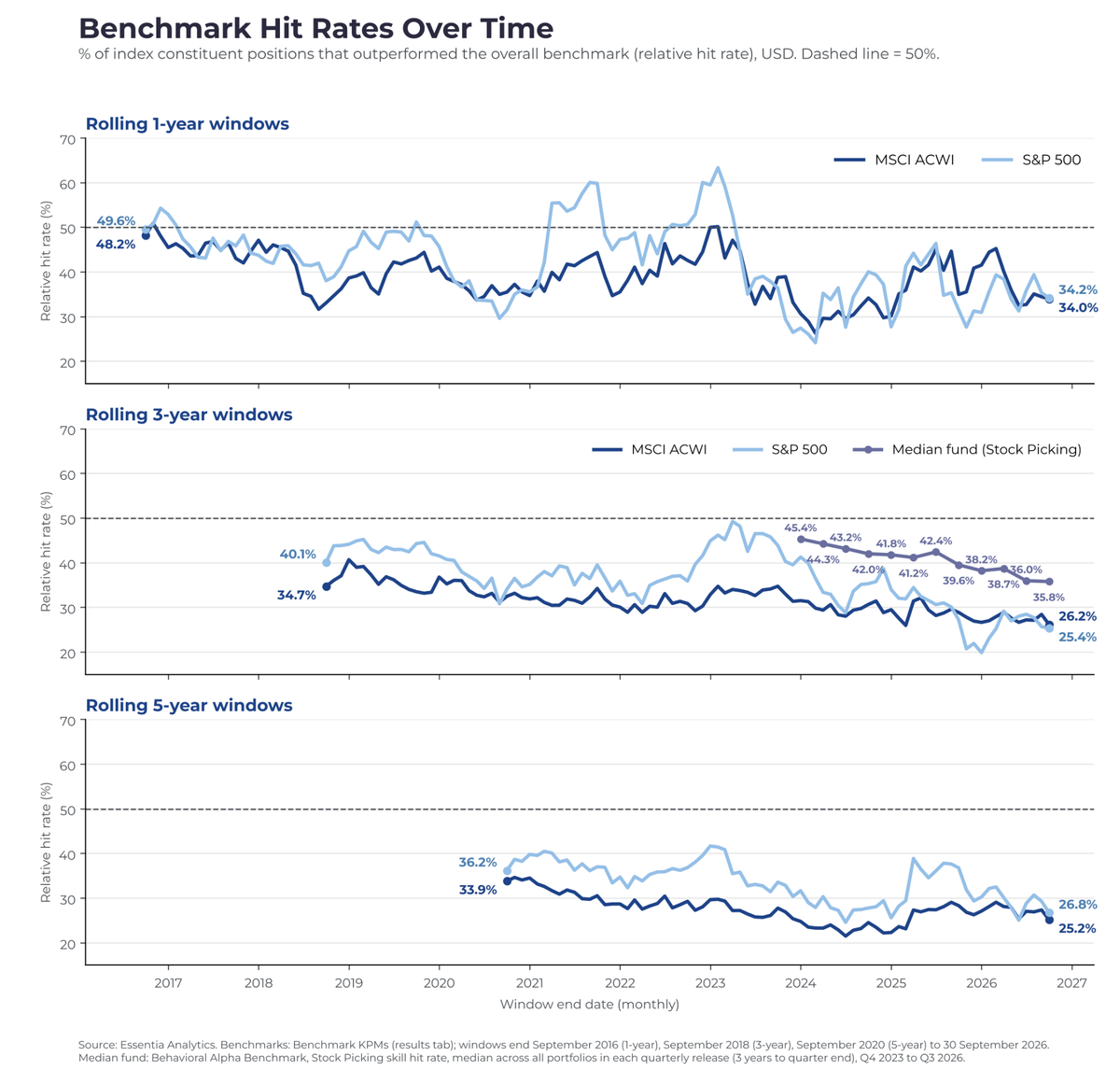
Each line above shows how many stocks in an index beat the index itself over a rolling window. At the dashed line, half of them do. The three-year panel adds the median fund’s stock picking hit rate, for comparison.
It used to be that about half the stocks in the benchmark outperformed it in any given year. Now that’s more like 34%. An active fund manager is expected to do better than that – and they have: according to the Behavioral Alpha Benchmark, the median manager’s stock picking hit rate over the 3 years to 30 September was 35.7%. But the lower the base rate, the harder the job – and the more a manager’s result depends on whether they owned the handful of names within that 34% that are driving the market.
Meanwhile, in many cases, the mandates of the funds they are running actually make it impossible for them to own index-level positions in the biggest winners (think NVDA), and therefore, in a market like this one, to outperform.
In 2024, the top ten holdings of the Russell 1000 Growth made up 60% of that index. A US mutual fund that registers as “diversified” under the Investment Company Act of 1940 must have at least 75% of its assets in positions of no more than 5% each. The test applies when the fund buys: a position can grow past 5% as its price rises, but the fund cannot add to it, and only the remaining 25% of assets is free of the limit. Separate tax rules for regulated investment companies cap any single issuer at 25% and limit positions of 5% or more to 50% in aggregate. In Europe, UCITS funds face the 5/10/40 rule: no more than 10% in any one holding, and holdings above 5% no more than 40% in total.
A diversified growth fund cannot buy its way to its benchmark weights. That is why FTSE Russell now publishes capped versions of its style indexes, and why some funds have given up their “diversified” status altogether to get around the rule.
Even the S&P 500 now runs into this issue. Counting Alphabet’s two share classes as one company, four companies are each more than 5% of the index, and together they make up more than a quarter of it – above the 25% allowance. A diversified fund could not buy all four at index weight. And few fundamental investors would choose to put more than a quarter of a diversified fund in four stocks anyway.
We find ourselves with a system in which a manager can be penalized for underperforming a portfolio they are either not permitted, or would not choose, to own.
The results show up exactly where you would expect. In 2025, 79% of active US large-cap funds underperformed the S&P 500, the fourth-worst year in the 25-year history of S&P’s SPIVA scorecard. S&P itself attributed it to “unrelenting large-cap outperformance.” Just 31% of S&P 500 stocks beat the index that year.
The index providers have noticed – up to a point
The index providers have made changes. In July 2023 Nasdaq ran a special rebalance of the Nasdaq-100 to reduce the weight of its largest members. In September 2024 S&P Dow Jones Indices changed how it caps its Select Sector indexes, after Microsoft, Apple and Nvidia kept flip-flopping in and out of the caps in the technology sector index.
In March 2025, FTSE Russell introduced capping on its US style indexes – no single company above 22.5%, and companies at 4.5% or more capped at 45% in total – while keeping an uncapped version alongside.
Has it helped? Not much – and that’s not really surprising. A cynic would say that these are compliance fixes designed to protect the index provider’s revenue line by keeping the indexes usable by funds that must meet diversification rules. Whether or not that is the driver, as pension fund consultant Callan observed of the Russell change, the caps do not address concentration itself – they move the goalposts a few inches. The S&P 500 top ten still sits at around 40%.
Why an equal-weighted benchmark is a better answer
An active manager adds value in two ways: by choosing which stocks to own, and by choosing how much of each to own, at any given time.
There was a good case for using cap-weighted indexes as benchmarks back when most mutual funds were launched. It is a proxy for what the average invested dollar holds. It assumes almost no decision-making and therefore no investment skill. Judged against the market as a whole, cap weight is the neutral position.
But times have clearly changed. Today’s market portfolio, as we have already seen, is a riskier one than an investor who believes in diversification would knowingly choose. An equal-weighted benchmark would be a less risky version of the same thing.
An equally-weighted index assumes that all the securities in the universe have the same expected returns and volatility. It is what a stock picker would hold if they had no reason to prefer one name to another. It is not assumption-free – holding equal weights means regularly trimming what has risen and adding to what has fallen – but its assumptions describe the starting point of an active manager’s job, not a view on how to do it. Beat it, and you have shown that your decisions – which stocks, and how much of each – added value over having no opinion at all. That is exactly what an investor is paying an active manager for.
Equal weight is not perfect. It tilts toward smaller and cheaper companies, and requires regular rebalancing, which adds cost for index providers. But I would point out that it also gives them something to appease angry active manager customers who feel trapped, paying an ever-increasing price for index data they do not feel actually adds value.
So why don’t all funds change their benchmarks?
The main reason funds don’t change their benchmarks is that they understand that allocators see it as a negative – it smacks of “moving the goalposts.” If nothing else, it potentially triggers an operational process that may lead the allocator to consider moving the mandate. To the manager, it feels like a risky move – and it takes resources to implement.
Research substantiates the industry’s negative impression of benchmark changes. Kevin Mullally and Andrea Rossi studied 2,870 US mutual funds between 2006 and 2018 (Review of Financial Studies, 2025). More than a third of the funds changed their benchmark at least once – so it’s not actually that rare.
Guess what Mullally and Rossi found: funds with high fees, broker distribution and poor recent performance were the most likely to make a switch. The new benchmarks tended to have had lower past returns than the original ones, so the poor past performance looked less bad. And it worked: those funds attracted about $70 million more in flows over the next five years, despite continuing to lag their peers in performance.
So what would happen if managers switched to equal weight benchmarks now? Looking at the S&P 500, the cap-weighted version beat the equally-weighted one in 2023, 2024, 2025 – and, as of the end of September, it was winning for 2026, as well. So a manager switching now would indeed flatter their recent record – albeit the advice from compliance would be to only use the new benchmark going forward, so as to stay GIPS compliant.
But over the long run, equal weight has actually been the harder benchmark to beat. S&P DJI’s own 20-year review found the S&P 500 Equal Weight returned 11.48% a year, vs 10.29% for the S&P 500. Equal weight is not the easier yardstick – it’s just the right one.
Equal weight is not the easier yardstick – it’s just the right one.
What if the concentration is about to unwind? When it does, managers who under-own the biggest names will finally have their day; if you switch now, you’ll miss out, right?! I invite you to count the biases underlying that thought – but it’s a natural, understandable one.
The best time to switch is now, and the reason is that the yardstick shouldn’t be chosen for the part of the cycle it flatters. A manager who looks brilliant while concentration unwinds is no more skilled than one who looked poor while it built. Equal weight takes that swing out of the comparison, and makes it easier for everyone involved to distinguish luck from skill.
Why allocators should encourage it
Investors looking at a decade of active funds trailing the cap-weighted index could be forgiven for concluding that it’s time to give up on active management altogether. Some already have. The benchmark isn’t active management’s only problem, of course. Fees matter, and according to S&P, over longer periods, active managers as a group have trailed the equal-weighted index too, net of fees.
But an investor in a cap-weighted S&P 500 fund today has around 40% of their money in ten companies whose fortunes increasingly rest on a single theme: AI. That may be a perfectly reasonable choice for some investors, but it is a concentrated position, not a diversified one.
Then why not simply buy an equal-weighted index fund? Again, that’s a reasonable choice, depending on your needs.
But the case for active management was never that every manager beats the no-opinion portfolio. The point is that some can – and an equal-weighted benchmark gives you better visibility into which ones.
An allocator or fund buyer who wants to use active managers to diversify will have the best probability of success if the benchmark is actually an appropriate neutral measure of the task they were hired to do.
An equal-weighted benchmark would serve the end investor in three ways:
- It reduces the incentive to hug the benchmark. A manager measured against a concentrated index faces enormous career risk if they under-own the biggest names. The rational response is to own them, regardless of the view on fundamentals. End investors then pay active fees for something close to index exposure. Change the yardstick – and give managers genuine room to deviate from it – and you remove the pressure to do that.
- It delivers real diversification. Many end investors already own the cap-weighted index through their passive holdings. An active manager free to hold genuinely different weights gives investors something they don’t already have.
- It produces a cleaner signal of skill. When the benchmark is a portfolio with no particular conviction, outperformance tells you something about the manager’s decisions, not about whether the manager happened to own Nvidia. For allocators, that means better hiring and firing decisions: keeping managers who have demonstrated skill and letting go of those who haven’t, rather than rewarding whoever happened to be on the right side of a momentum run.
What you can do about it
Benchmarks don’t change on their own. Most asset managers won’t move without a nod from their clients, so the first step sits with allocators. Three conversations would get it started:
- Look at a comparison. Whatever a fund’s official benchmark, ask the manager to show performance against an equal-weighted version of the universe they actually invest in. The manager hasn’t actually been running the portfolio to that benchmark, it’s worth pointing out, but it costs nothing and it starts a conversation.
- Agree what success looks like. Do you and your manager share a view of what they were hired to do? If the answer is “invest in good businesses”, the benchmark should reflect that, and leave them room to look genuinely different from it.
And to managers:
- If you decide on a switch, do it properly. Make the change openly. Show the full history against both the old and new benchmarks, and keep the cap-weighted index as a secondary reference. If you do apply the new benchmark retroactively, acknowledge that a switch after three years of cap-weight leadership will flatter recent numbers.
- You don’t have to wait to be asked. You’ve likely looked at your performance compared with an equal weight benchmark. Ignoring whether it flattered or penalized past performance, would it make more sense as your benchmark than what you’re currently using?
The point of a benchmark is to measure the value a manager adds. Let’s use one that does.
This article is for information and discussion only. It is not investment advice and does not recommend any security, fund or index.
Sources
- State Street Global Advisors, SPDR S&P 500 ETF Trust (SPY) fact sheet, as of 30 September 2026 (top 10 holdings and S&P 500 index returns).
- RBC Wealth Management, “The ‘Great Narrowing’: S&P 500 concentration.”
- Laurium Capital, “Just how top-heavy are global equity indices today?”, Daily Maverick, 26 August 2026 (sponsored content).
- Callan, “Russell Index Capping: Key Facts and the 5/50 Rule Effect.”
- Investment Company Act of 1940, Section 5(b)(1), 15 U.S.C. 80a-5(b)(1).Sections 5(b)(1) and 5(c), 15 U.S.C. 80a-5.
- iShares MSCI World ETF (URTH) fact sheet, as of 30 September 2026 (United States weight).
- interactive investor, “How fund rules can make some pros forced sellers when a stock soars,” 5 December 2023.
- S&P Dow Jones Indices, SPIVA U.S. Year-End 2025.
- MFS, January 2026 market insights (citing Bespoke and Bloomberg).
- Reuters explainer on the Nasdaq-100 special rebalance, July 2023.
- S&P Dow Jones Indices, “Explaining Changes to Select Sector Indices,” Indexology, 10 September 2024.
- S&P Dow Jones Indices, “The S&P 500 Equal Weight Index: A Supplementary Benchmark for Large-Cap Managers’ Performance” (data to 31 March 2018).
- Mullally, K. and Rossi, A., “Moving the Goalposts? Mutual Fund Benchmark Changes and Relative Performance Manipulation,” Review of Financial Studies 38(4), 2025.
- Mullally, K. and Rossi, A., “How Mutual Funds Change Benchmarks to Manipulate Performance,” CLS Blue Sky Blog, 29 August 2022.
- S&P Dow Jones Indices, “More Equal Than Others: 20 Years of the S&P 500 Equal Weight Index,” June 2023.
- S&P Dow Jones Indices, SPIVA U.S. Mid-Year 2026, as summarised by TKer, “Most stock-picking pros have been underperforming this year’s rollercoaster ride higher.”
- Opening Bell Daily, “Equal-weight vs S&P 500: mega-caps retook the 2026 lead,” 15 October 2026; ChartRow, “S&P 500 Equal Weight YTD Return 2026” (estimates).
